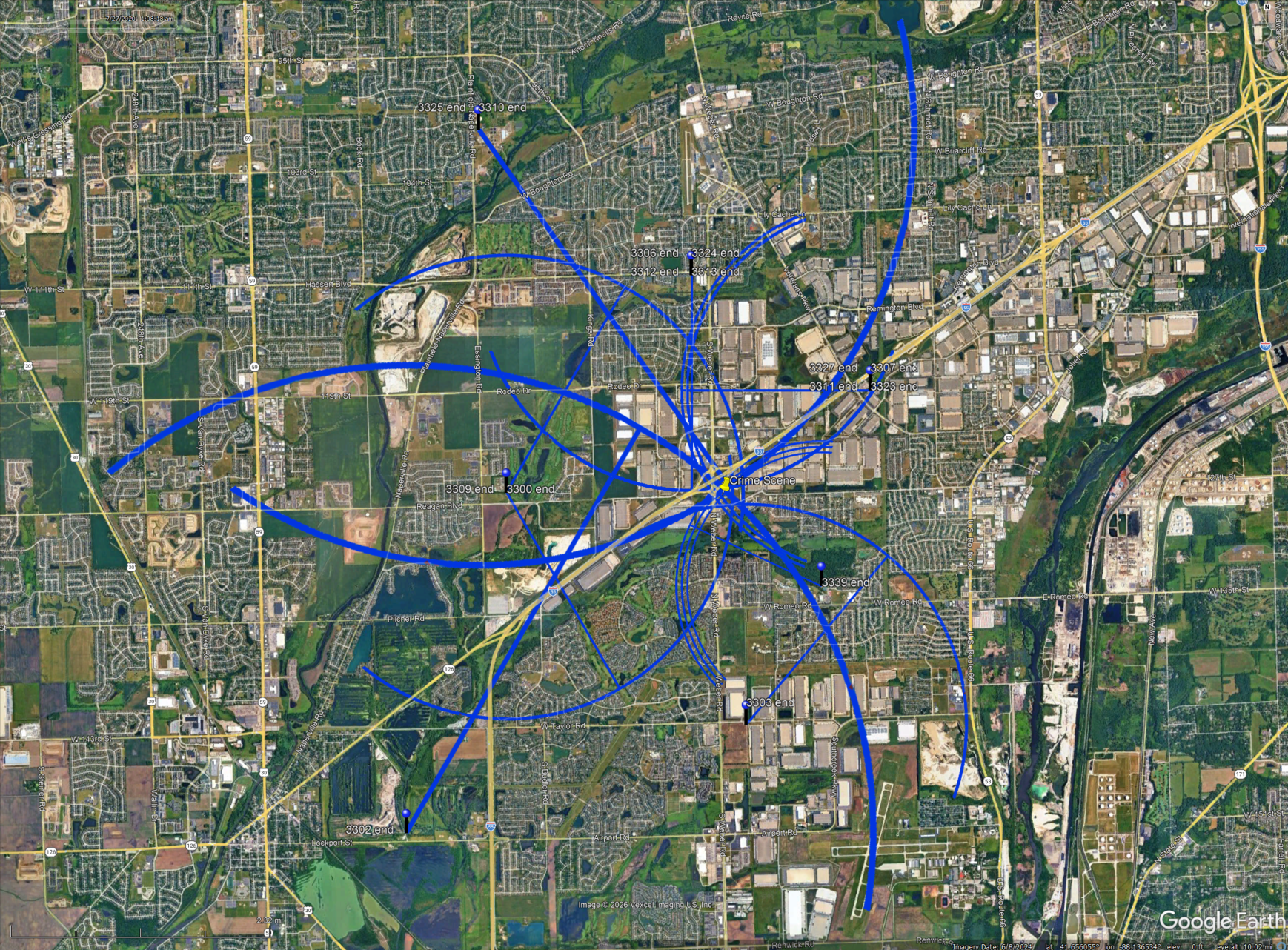
Timing Advance (TA) is used in 2G GMS/4G LTE/5G NR cellular networks to synchronize the cellular device’s uplink signal with the downlink signal from the cell site. As a further away cellular device will take longer to transmit and receive a cellular signal from a cell site than a closer cellular device (with line of sight to cell site), TA calculated by the cell site allows the network to determine the propagation delay. TA allows the cellular network to then send a Random Access Response (RAR) to the cellular device to either tell the cellular device to advance or retard the timing of its uplink signal. These TA measurements are performed numerous times throughout the connection as new TA commands are routinely sent to the cellular device. TA also allows the network to share the capacity of the cell site with many users in a similar geographic area. Since the speed of the signal is a constant speed of light speed (186,282 miles per second), the calculation to determine the delay is 1/2(Round Trip Time x speed of light).
From the propagation delay, a distance from the cell site can be inferred. Depending on the cellular technology, the width of the TA band will vary. In 2G GSM, the TA band width is 550 meters wide. In 4G LTE, the TA band width is 78 meters wide. In 5G, the TA band width will be at maximum 78 meters wide but will decrease based on the subcarrier spacing (SCS) used. At 15 kHz SCS, the width is 78 meters wide. However, as the SCS increases by a factor of 2, the width decreases by 1/2. At 30 kHz SCS, the TA band width is 39 meters wide and at 60 kHz, the TA band width is 19 meters wide.
T-Mobile, AT&T, and Verizon all can provide TA data in a report while Verizon will call their data RTT (Real Time Tools). When combining knowledge of cell site and sector locations, a trained analyst can use TA data to assist in determining the estimated historical location of a mobile device based on the inferred distance estimations. TA is different from estimated point locations that can also be provided by AT&T and T-Mobile. These estimated point location records are sometimes provided in the same report containing a latitude and longitude coordinate and sometimes an inaccuracy value. While estimated point locations do use proprietary technology and are known to have greater inaccuracies in location estimations, TA is not proprietary, is well known, documented, and has to be followed by cellular networks without any deviation.
While most cell site analyst practitioners understand the reliability of TA data in historical cell site analysis, there are some that attempt to discredit its use. While there is no debate that GPS can provide a reliable estimation of a device, even GPS can have some errors due to the environment the device is in. While TA is not an exact or precise location estimation as GPS can be, a properly trained and experienced practitioner can find TA data to provide a reliable location distance estimation when taking into account the technology constraints (band width) along with environmental issues that can cause multipath propagation leading to a longer signal delay. This longer signal delay can result in the reported TA distance estimation being slightly further away from the cell site than the actual location of the cellular device. However other factors such as rounding can offset some of the error caused by multipath.
While proponents and opponents of using TA data to estimate the historical location of a cellular device can debate on its usage and hypothesize on potential error factors, proper testing of the TA reliability can be the deciding factor that a judge or juror can rely on.
There are three ways to test TA reliability:
(1) Using SIM based radio frequency survey equipment to measure TA.
(2) Using an application on a cellular device to capture TA data.
(3) Use test phones and obtaining TA data from the cellular provider
While all three methods can obtain TA data, the most accurate method to compare TA accuracy from cellular provider records would be using test phones and comparing the TA data from the cellular provider reporting to the test phone’s GPS location. While the first two methods also obtain valid TA data, what happens behind the scenes with the cellular providers collection of this data and final report processing that is commonly used in a court of law can only be determined with the test phone TA collection method.
In 2025, I performed test phone TA reliability testing using 3 cell phones for each of the three main cellular carriers. I used a Rohde & Schwarz TSMA6 cellular network scanner to capture my GPS location data along with the cellular network data. Drive tests were performed in Joliet, IL, the surrounding suburbs, in downtown Chicago, and the surrounding Chicagoland area. The TA data was obtained directly from the cellular providers using consent requests which were compared to the actual location of the cell phones.
The data I collected was combined with data from other researchers in Vermont, Maine, Florida, Michigan, Oregon, and other locations. This data was then analyzed by Joe Hoy, Martin Griffiths, and Cory Brodzinski from Forensics Analytics to determine the accuracy of TA data across the United States.
22,559 TA events were analyzed from all locations resulting in an accuracy of the device being within +/- 1/10 of a mile (approximately 530 feet) of the reported distance estimation from TA at least 89% of the time with all three providers combined.
When comparing the cellular providers individually the following was found.
AT&T: 72% accuracy within +/- 1/10th of a mile and 90% accuracy within +/- 2/10th of a mile
T-Mobile: 93% accuracy within +/- 1/10th of a mile and 98% accuracy within +/- 2/10th of a mile
Verizon: 89% accuracy within +/- 1/10th of a mile and 97% accuracy within +/- 2/20th of a mile
The debate on whether TA data can be reliable, is testable, and has known error rates has been decided. Those in the field that still believe TA is unreliable and should not be used in historical cell site analysis is likely due to that person’s lack of knowledge and experience using and analyzing TA data. I would challenge anyone that disagrees with TA reliability in estimations to actually test TA data in a proper manner like others have already done.
The full report on the updated Timing Advance white paper from Forensic Analytics can be obtained using the download link below and/or by visiting Forensic Analytics' website:
https://www.forensicanalytics.io/us/timings-advance-research-white-papers/